
On July 12 Professor Ariadne Vromen of the University of Sydney will present her ideas on the impact of social media and digital politics on the way in which advocacy organisations mobilise and organise citizens for political action.
Andrew Chadwick and Cristian Vaccari Speaking at King's College London Conference on the CyberParty, May 13

Newpolcom's Professor Andrew Chadwick and Dr Cristian Vaccari are speaking at next week's CyberParty conference at King's College London.
Hosted by the new King's Centre for Digital Culture (Director: Dr Paolo Gerbaudo), the conference will examine the significance of the new party formations whose organizational infrastructure and political identity is heavily shaped by their use of digital communication technologies, such as Podemos, the 5 Star Movement, Syriza, and the Pirate Parties in Germany, Sweden, and Iceland. The event will also examine recent party change in which digital media have played an important role, such as Jeremy Corbyn's rise to become leader of the British Labour Party, and Bernie Sanders' U.S. primary campaign.
Andrew will be sharing ideas and findings from the forthcoming special issue of the International Journal of Press/Politics on "Digital Media, Power, and Democracy in Parties and Election Campaigns" that he co-edited with Professor Jennifer Stromer-Galley. The special issue features an article by the editors and six papers examining digital media and party change in a wide range of countries.
Andrew's talk, which features in the Opening Plenary, is entitled "They’re Parties, But Not as We Have Known Them: Digital Media and (Dis)organizational Renewal."
Cristian's talk, in the session on Digital Demands: Policies and Cleavages, is entitled "Old, New, or Just Different? An Overview of Cyberparty Supporters."
More information on the conference can be found at the Centre for Digital Culture website.
Newpolcom to present on #PrayforParis #PrayforSyria at SOAS on Saturday

One of many visual memes circulating on Twitter in late 2015.
What political points were Twitter users around the world trying to make when they used the hashtags #PrayforParis and #PrayforSyria in the wake of the 2015 Paris attacks? A new research project will be presented by NPCU researchers at a conference at SOAS in London on Saturday 7 May 2016 that shows the political dynamics that unfolded. The conference, Communication and Conflict: Iraq and Syria features a great line up of speakers, including keynotes from Philip Seib and Lilie Chouliaraki. Please find details and a link to the programme here. Below are details of the NPCU research.
Media, Migration, and Violence: #PrayforParis, #PrayforSyria and the Dynamics of Antagonism
Authors: Billur Aslan, James Dennis, Ben O’Loughlin and Cristian Vaccari
Abstract:
This study examines public responses on social media to the 13 November 2015 attacks by Islamic State on Paris. Analysis of over 2 million tweets containing the hashtags #prayforparis and #prayforsyria in the days after the attack indicate these hashtags hint at the conflation of three issues: (i) migration: were the attackers homegrown or carrying overseas passports? (ii) violence: why was Paris attacked and why is France bombing Islamic State? (iii) media: what role should mainstream media and social media play during such events that are both local and global, immediate and historic, unique and yet part of a series? In the event’s aftermath, debates raged about whether news media and sites like Facebook offer disproportionate attention to casualties in Paris when catastrophes were unfolding simultaneously in Lebanon, Japan and elsewhere. Social media users shared reports of a massacre in Nigeria as live news despite the event occurring the previous April. Such debates condition immediate public and policy responses – the backlash – but also shape how our public sphere functions in the long term. With #prayforsyria, Syria’s conflict, migrants and refugees became woven by general publics into a broader translocal media-security nexus. How does this work?
This paper builds on previous research exploring how social media affordances encourage certain communication behaviours. We test the hypothesis that the reply function on Twitter is more conducive to antagonistic comments than the retweet function. This is based on two bodies of theory. First, in political communication research we know that the reply function has a higher cognitive demand than the retweet function and thus demands greater commitment. Second, from social theory we know that the reply function has a higher affective demand that the retweet function. It involves greater ‘identity work’: one risks one’s ‘face’ in directly posting a comment to the original commenter. Retweeting can be done with one click whereas replying demands a degree of creativity. In short, the threshold for action is higher with replies compared to retweets which are easier, practically, cognitively, and affectively. Hence, we expect to find greater polarisation and antagonism in replies than retweets. By contrast, we expect retweets to be more likely to express solidarity, comprehension, and appeals to universal values, as these are generally considered the most appropriate responses in the aftermath of a crisis and are thus more likely to be subject to dynamics of reinforcement based on social desirability. Did retweets bring Syria “into the fold” of Europe or the international community?
This research contributes to two non-academic concerns. First, should mainstream and social media organisations like Twitter design the affordances of their social media spaces to encourage certain forms of transnational public deliberation? Second, journalists, celebrities and other high profile figures take on a particular burden during global media events. They can cultivate cosmopolitan, open and cross-cultural dialogue or trigger partisan, closed and antagonistic dialogue. This has a bearing on how public spheres function, particularly a public sphere like Europe’s that is already divided by language.
Dual screening discussion at Sheffield Politics

Ben O'Loughlin will present his ongoing research on dual screening with Andrew Chadwick and Cristian Vaccari at the DIgital Society Network and the Department of Politics at the University of Sheffield today. Details below.
Wednesday 27th April 2016
Location: Room G18, Elmfield Building
Time: 1:00-2:00PM
Engaging to Influence: Why People Dual Screen Leaders Debates
Abstract
Dual screening—the complex bundle of practices that involve integrating live broadcast media and social media—is now routine for many citizens during important political media events. But do these practices shape political engagement, and if so, why? And if dual screening does shape engagement, can parties and their supporters harness this? We devised a unique research design combining a large-scale Twitter dataset and a custom-built panel survey focusing on the broadcast party leaders’ debates held during the 2014 European Parliament elections in the United Kingdom. We find that relatively active, “lean-forward” practices, such as commenting live on social media as the debate unfolded, and engaging with conversations via Twitter hashtags, have the strongest and most consistent positive associations with political engagement. Running a second iteration of this methodology during the 2015 British General Election, we identify how some users have come to approach dual screening strategically as one more opportunity to achieve influence before, during and after a political media event.
The Digital Society Network draws together an interdisciplinary team of researchers engaged with research at the cutting-edge of society-technology interactions.
Thanks to Helen Kennedy for organising the seminar.
O'Loughlin and NSC to debate learning from the mistakes of the War on Terror, 21 April, Washington DC

Ben O'Loughlin of the NPCU and Courtney Beale, Senior Director for Global Engagement at the National Security Council, United States.
Ben O'Loughlin and Courtney Beale, National Security Council, will lead a debate on 21 April 2016 in Washington DC titled, Countering Violent Extremism: Towards a New Era of Peacebuilding. The event is hosted by the British Council and New York University. This is the final debate in a series, Iconoclash, featuring Salman Rushdie, Tasoula Hadjitofi, and Slavoj Zizek.
Details:
Thursday, April 21, 2016, 6:30 – 8:30 pm
Countering Violent Extremism - Towards a New Era of Peacebuilding
New York University, 1307 L St. NW, Washington, DC 20005 (Metro: McPherson Square)
To RSVP click here.
The panel series Iconoclash has been an enquiry into cultural and value systems connected with terrorism in the Middle East and the West. The project aims to better understand the cultural complexity and role of media in the rise of Islamic extremism, as well as the roles we all play. Extremists’ conquests of regions and cities, whereby they harm people, annihilate memory, remap geopolitics and impose apocalyptic imagery and narratives, universalizes their idea of order and submission. Their apocalyptic imagery and declamations are propagated through social media and have gained international attraction and relevance. To overcome the persisting threat requires more than military hardware. But what is actually needed to achieve lasting peace in this region of the world and with its inhabitants?
This final panel provides an overview of the lessons learned from over twenty years of interacting with Islamic fundamentalism. How do we bridge the gaps in trust and understanding? How do we build dialogue and cooperation on an equal level? What can the arts or other means of cultural interaction contribute to overcoming the bottleneck of dialogue? How can we successfully use social media for such ends?
Cristian Vaccari discussed political storytelling at the International Journalism Festival

On April 7 Dr. Cristian Vaccari spoke at the International Journalism Festival (#ijf16) in Perugia. The panel, titled "Lies, damned lies and storytelling?"also featured leading political and communications consultants and discussed the uses and usefulness of narratives and storytelling techniques in contemporary political communication.
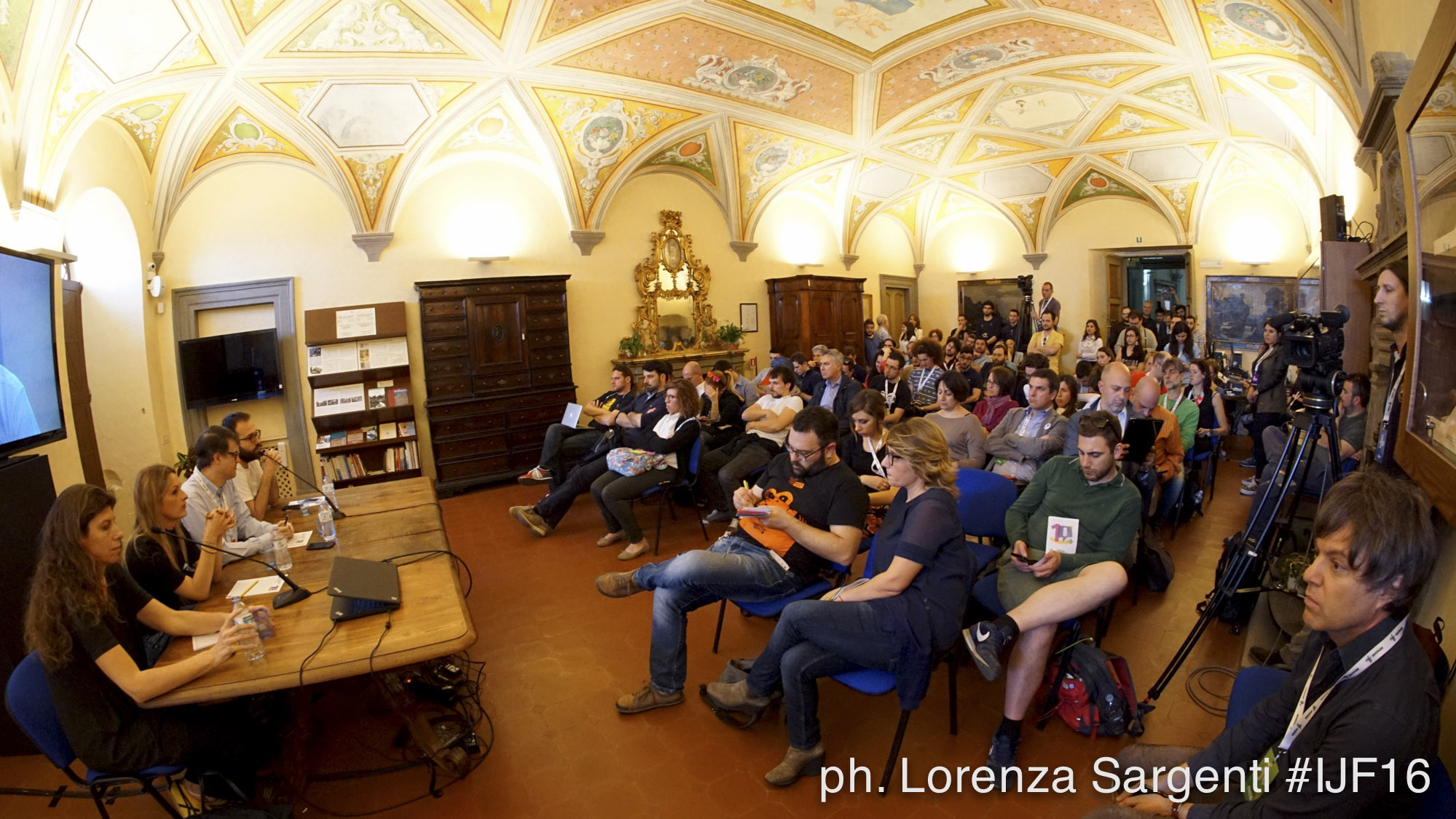
Here is a roundup of the discussion (in Italian). Below you can watch the video of the whole panel, which was conducted in Italian.
Andrew Chadwick speaking at the University of Vienna, April 25, 2016
On April 25 Andrew Chadwick will be speaking at the Department of Communication at the University of Vienna about the latest findings from the Hybrid Media System Project.
Time: 4.30–6pm
Place: Währinger Straße 29, SR4
Newpolcom Research at the Political Studies Association Annual Conference — Roundup

Politics and the Good Life was the theme of the recent Political Studies Association (PSA) Annual International Conference, held on the 21-23rd March in Brighton. The Good Life refers to the ancient Athenian concept which framed their thoughts on politics, ethics and knowledge. The conference considered how the term resonates today.
Ellen Watts put forward an analysis of how celebrity endorsers of the Labour party attempted to perform authenticity through the language of their endorsements and how they were received on social media. In particular, the extent to which these evaluations were influenced by negative interventions by Conservative bloggers and journalists.
Andrew Chadwick presented a paper, written with Nick Anstead, exploring the online behaviour of the think tank the Institute for Fiscal Studies. Drawing upon 16,664 elite-produced tweets, the research examined how the key affordances of Twitter are used in the co-construction and propagation of think tank authority.
Cristian Vaccari argued for the importance of the relationship between online voter mobilization and aggregate measures of online and offline political engagement in Germany, Italy and the United Kingdom during the 2014 European election campaign. Results indicated that online mobilization may contribute to closing gaps in political engagement at both individual and aggregate levels.
Jinghan Zeng presented three papers considering the topic of the Good Life for China from three different angles. Firstly, he examined China’s proactive approach to embrace big data to improve its governance, in particular the “big brother 2.0” model. Secondly, he presented an understanding of Chinese power from a Chinese perspective by analysing Chinese news articles titled with “new type of great power relations”. Finally, he presented a study of the survival strategies of the Chinese Communist Party, in particular how it continually revises the ideological basis that justifies its rules.
Adam Drew and James Sloam were also at the conference speaking on security and youth in politics respectively.
If you’d like to read more about the conference, you can visit the PSA website
Russia’s narrative on terror in Europe – Joanna Szostek at the Milton A. Wolf Media and Diplomacy Seminar
Dr Joanna Szostek was invited to address participants of the 2016 Milton A. Wolf Media and Diplomacy Seminar in Vienna, Austria this week. This year the seminar provided a platform to discuss the multiple anxieties which came to the fore in international relations following the terror attacks in Paris and Brussels. As a participant in the first panel on ‘Narratives of Global Conflict and Negotiation Post Paris’, Dr Szostek unpacked the abrasive narrative projected by Russia in response to Islamist terrorism in Europe. Countering claims that Russia’s ‘propagandistic’ communication efforts are designed only to mislead and confuse, Dr Szostek argued that Russia’s narrative reflects its leaders’ genuine long-term objectives, including their strong desire for acceptance by other European powers.
Thanks as ever to Monroe Price, Amelia Arsenault and all those who make the Milton A. Wolf Seminar possible.
Andrew Chadwick To Deliver Keynote Address to the Annual Meeting of Finland's Association of Media and Communication Studies, Helsinki, April 8
Andrew Chadwick is the keynote speaker at the opening ceremony of Mevi16, the annual meeting of Finland's Association of Media and Communication Studies. The conference will be held Friday 8 and Saturday 9 April, 2016, at the Arcada UAS campus, Helsinki.
The title of Andrew's talk is "Media, Engagement, and Political Power Today: Rebalancing the Information-Action Ratio."
Here's the theme:
"The information-action ratio is a powerfully pessimistic theme in Neil Postman's classic work of broadcast-era media criticism, Amusing Ourselves to Death. Drawing on my research on the interactions between political elites, professional media, and citizen activists, in this talk I will consider if, in the era of the hybrid media system, the information-action ratio is being rebalanced. When it comes to political communication, are mass publics still stuck in a 'great loop of impotence'?"