16 days of action for Darfur

A really interesting Facebook powered campaign organised by the people at Globe for Darfur. A while back they created a group called 16 Days of Action and started recruiting people to join it.  The aim of the group was to get members to engage in 16 forms of activism over 16 days, such as sending a video for Darfur, posting a blog entry about the crisis, and phoning your political representatives.

What is interesting about this campaign is that it seems to be wholly Facebook based (the only url on the press release launching it is the Facebook address). I reckon this can be interpreted in two ways (which aren't mutually exclusive).  It can certainly be seen as an inspired or powerful use of social networking to cheaply and quickly organise a campaign.  But additionally, it has to be asked whether it excludes people who don't use Facebook from participating - and in the process, overlooks potential supporters.

(Belatedly) happy Thanks Giving

There are certain rules I stick to on this very serious academic blog as opposed to my own weblog. Aside from the obvious "don't blog about cricket" rule, another really important one is "don't blog after drinking lots of margaritas"... but today I'm going to make an exception to that rule, as the party I have just been to was unexpectedly and very directly related to e-campaigning.

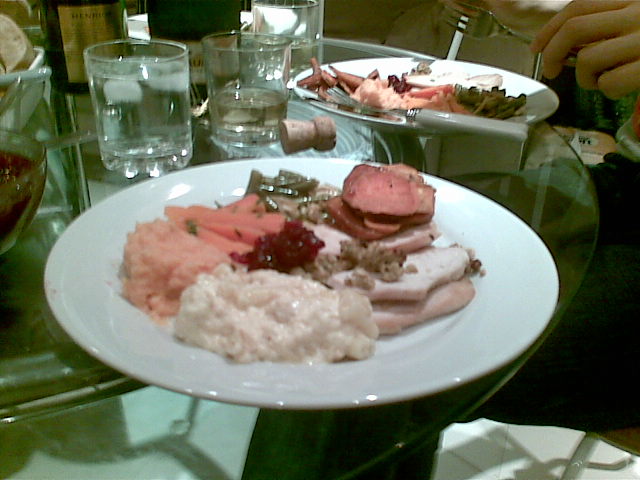
LovelyMeal.jpg

I was very lucky to be invited to a wonderful Thanks Giving party hosted by some friends this evening. The spread was nothing short of spectacular, as you can see from the picture - a soup starter, a main course with every conceivable trimming, and beautiful pies for dessert (and the aforementioned margaritas, which also made an appearance somewhere in the latter point of the meal - I'm a little hazy on the details).  It was a really wonderful evening. 

NastyMess.jpg 

I can't claim any credit for the cooking.  Indeed, the one task I was given was to whip up a sauce containing milk, garlic, vinegar and extra virgin olive oil.  However, due to a cooking mis-communication, it got blended instead of whipped - the end result being what can only be described as a garlic smoothie going in the bin (you can see the rather hideous mess I made in the photo above), and someone being sent out to buy some humus as a replacement. I can only claim incompetence as a defence...

However, what was particularly interesting about this party was where many of the recipes had come from... or more specifically, who they came from - John Edwards. I had vaguely noted the story that Edwards was giving family recipes away to those who donated to his campaign, but I never thought that I would actually be able to go to a party where these recipes made up a large proportion of the meal served (I also should add that the hideous garlic smoothie was not an Edwards recipe - that belonged to the BBC Good Food magazine).

It struck me, as I was tucking into this fantastic spread, that this kind of campaigning would simply not have been possible without the Internet. The gathering of donations is faster than ever before, as is the ability of campaigns to communicate with those who have given them donations (or, most crucially of all, might give them more donations in the future). That's why John Edwards's Thanks Giving recipes makes sense and has been so effective (and tasty, I hasten to add).  It also globalises the campaign to a far greater degree. 

I know this blog has many reader all over the world, so can I just take this belated opportunity to wish anyone reading in the US a very happy Thanks Giving.   

What is Al-Jazeera English for?

AJILogo.jpgWe have recently witnessed a huge growth in the number of transnational English-language television channels. This workshop led by Prof. Marie Gillespie of the Open University and Dr. Ben O’Loughlin of Royal Holloway, University of London, focused on the purpose of these channels. Given that Qatar, France, Russia, Iran and China have all recently launched English-language TV stations, does this mean countries only feel they count as a ‘power’ if they have a voice alongside the BBC and CNN in the emerging ‘Anglosphere’? Are governments institutionalizing a new phase of public diplomacy in an attempt to influence other governments or publics? Or are these channels simply professional news providers, part of profit-making organizations?


Debate was anchored around two presentations. First, Dr. Mohammed El-Nawawy of the Queens University of Charlotte and Shawn Powers of the University of Southern California introduced their new study, Al-Jazeera English: Clash of Civilizations or Cross Cultural Dialogue? In the next year they will examine the impact of Al-Jazeera English in five countries, asking whether such media can have peace-making effects in world politics, acting as ‘conciliatory media’. Al-Jazeera English is an interesting case because journalists have an explicit mandate to give a ‘voice to the voiceless’ and produce news that does not offer casual demonisation, lack of context, or reduce debates to simplistic binary stand-offs. But why would the Emir of Qatar sanction this TV station alongside its Arabic version? And why recruit journalists from the West rather than from ‘voiceless’ regions? Debate focused not only on the purpose of this channel, however, but also on how researchers might ascertain its impact. For instance, few viewers have access to Al-Jazeera English at present, and those likely to reply to surveys or interviews about the channel are likely to be a self-selecting bunch: viewers who already approve of the journalistic ethos of Al-Jazeera English. How transnational media channels attempt to measure any ‘effects’ on audiences – conciliatory or otherwise – is a critical challenge in the coming years, and it remains to be seen how these channels will prove their value.


The second presentation drew on findings from the recent New Security Challenges Shifting Securities project by Marie Gillespie, Ben O’Loughlin, Prof. James Gow, King’s College, London and Dr. Andrew Hoskins, University of Warwick. The project explored how cultural and religious diversity affect news reception and the specific responses of British Muslims to media and security policy. It has also highlighted how changes in the technologies, ethics and practices of journalism shape the security stories and how they are interpreted. The study has been pioneering by connecting news producers, texts and audiences over time in ways that illuminate how audiences’ use of news contributes to their shifting perceptions of security and belonging. Insights from the Shifting Securities methodology will feed into several projects funded by the ESRC and AHRC in coming years, including in the New Political Communication Unit. An understanding of news consumption as a ritualised, social and situated process, not a matter of transmission of isolated messages to atomized viewers, can offer greater analytical purchase on questions of news credibility, the legitimation of security policy, and the ‘impact’ of media diplomacy around the world.


Darling, where did you leave my data?

It's certainly the biggest data protection scandal in British - if not world - history (details here, here and here). A junior tax clerk at HM Revenue and Customs copied a database containing 25 million records on to two CDs. The databases contained the personal details of every single UK citizen who claims child benefit - including their bank details and their mothers' maiden names, which has, for years, been the stock security question in any UK bank. The junior clerk then popped the discs (which were password protected but not encrypted) in the internal post, to be sent down to London. They never arrived. In all, the security leak is estimated to have put 7.25 million families at risk. Of course, there are no certainties that the discs have fallen into malevolent hands. But there is a horrible crushing uncertainty.

The political ramifications of this huge event are only really starting to be felt. It is quite easy to make the argument that this isn't really political in any meaningful sense, by which I mean related to the substance of policy (in fact, Jonathan Freedland cites just such an argument in today's Guardian). After all, some lowly HMRC official (who I imagine looks a bit like this) makes a balls up. What on earth does that have to do with the Chancellor of Exchequer? It is also easy to argue that (as Freedland goes onto, in fact) that the real impact of these events are perceptual.

The opening line of Simon Hoggart's Parliamentary sketch in today's Guardian rather neatly summarises the situation that Alistair Darling finds himself in:

Another day, another disaster - and this one was a stonker. The news that the private records and bank details of 25 million people were lying around on a computer disk, heaven knows where, like a Rockin' Good Christmas CD that's fallen out of a Sunday paper, was greeted by MPs with incredulity. They were less surprised by the fact that Alistair Darling was in charge. Poor Darling, or at least his department, is now seen as an ongoing accident blackspot.

I don't agree that this is wholly about perception. I think this this discussion has policy, as well as political content. Two arguments do suggest this is political in a meaningful sense. The first one was deployed by acting Liberal Democrat leader Vince Cable in the Commons yesterday, when he blamed the error on spending cuts that had occurred in the past ten years, which had ensured the civil servants were over worked and prone to making these kinds of errors. That seems a little like political semantics to me (Cable didn't actually quote any figures that I saw).

I think the second argument is much more compelling - and offers real reason to believe that, at the heart of this incident, lies a real policy problem. One of the defining technological developments in the past number of years has been the shrinkage, ubiquity and declining cost of massive data storage. To take one obvious example, your iPod nano can now hold considerably more data than a desktop could a decade ago.  By the same token, data has become more moveable, transferable and accessible. Access to the most complete and largest data sources has cascaded down the management structures of large organisations. There can be no doubt that this change has occurred on Labour's watch.

Therefore, it is no good simply arguing that this could have happened under a Tory government. It might have, of course. And there is no reason to suppose a Conservative ideology would pre-dispose to dealing with this any better. But the key point is this wasn't a one off event - a moment of madness where sensitive information was put in the post - but the near-inevitable end product of an inability to understand a new data environment created by a combination of technology and bureaucracy. Government should have spent a significant amount of time and effort in the past ten years trying to understand and develop systems for managing this new environment. Yesterday's events proved that they have not done so adequately and that is the great policy failure in this area.


Rapid response online

It's only 50 days to go until the Iowa caucaus, and according to media reports, Hillary Clinton has had a bad week in the states. I take that with a pinch of salt - her debate performance last week was marred by a bad answer right at the end  that left her open to attack and she has been accused of planting questions during campaign visits, but she is still twenty-odd points ahead in national polls, and leading in all the early primary states (check out this great Slate magazine polling site for further details). At the moment at least, it all smacks of people desperately trying to fill up column inches without a huge amount to go on.

But it also coincides with a new development in the Hillary campaign which at least implies they are concerned about being attacked - the fact hub. This is a rapid response website, trailed in the Fix column. It is an interesting use of the 'net, as it pushes one of the mediums biggest assets - speed - to the fore. However, it is also very top-down (for example, although it looks very like a blog, there is no commenting facility on it). For this reason, I wonder if it is a model that could be transfered to Britain well, on the grounds that it would not fundamentally compromise the hierarchical nature of our parties? For example, it is possible to imagine rapid response videos being put in response to party election broadcasts, overdubbed with "corrections" or with statements being questioned.


Emergency Blogging

The news is full of what is going on in Pakistan.

One of the most obvious changes compared to the coup of 1999 (when Musharraf took over power in Pakistan) is the proliferation of cable channels, internet cafes and electronic devices, especially in the major cities like Karachi and Lahore. Despite the general's best efforts to crush political dissent by blacking out TV stations, blogging has provided a great outlet for concerned Pakistanis to post pictures, audio and video of arrests and police baton-charges; to share information about the arrests of human rights activists and lawyers; and to express their views which are otherwise being cut off from the mainstream media (although many newspapers are still managing to take a critical stance too.)

The small sliver of society with access to the internet is an elite, English and Urdu speaking group but it is also, in many places, exactly the same group which is being targeted by 'the Emergency': lawyers, academics, journalists and so on. One professor and human rights activist from an elite Lahore institution was even able to send news of his arrest via his Blackberry - his message was later posted up on a site. Pakistanis in Europe and the US and elsewhere in the international diaspora are also airing their views, protesting and using the web to find out what's going on inside the country. Take a look at Chapatimystery.com, Pakistaniat.com and Help-Pakistan.com.

Also check out the Don’t Block the Blog Campaign which is an older campaign which predates the Emergency -- working to keep ISP's out of politics and to protect the rights of bloggers in Pakistan; some were blocked for showing the controversial cartoon images of the Prophet in 2006.

Research Assistant Post

Politics & International Relations
New Political Communication Unit

Research Assistant

Salary: £29,600 per annum, inclusive of London weighting
1-year full-time appointment beginning 7 January 2008

Applications are invited for a Research Assistant to join a team working on an interdisciplinary project entitled, ‘Legitimising the Discourses of Radicalisation: Political Violence in the New Media Ecology’. The research is funded by the ESRC New Security Challenges Programme, ‘Radicalisation’ and Violence – A Critical Reassessment.

The successful candidate will work with Dr. Akil Awan and Dr. Ben O’Loughlin at the New Political Communication Unit, based in the Department of Politics and International Relations, and with colleagues at the University of Warwick. The candidate will identify, collate, and analyse a range of online and other media content, and will be expected to contribute fully to activities and dissemination organised within the remit of the project.

The successful candidate will have a master’s degree and preferably a PhD in a relevant discipline, or equivalent research experience. Fluency in Arabic and knowledge of qualitative research methods are essential. Familiarity with media discourse analysis, Web 2.0, and some knowledge of the current security context as it relates to issues of radicalisation and the global war on terrorism would also be desirable.

For full details of how to apply, please see Royal Holloway's Personnel pages.

Lest we forget

WarGravesCropped.jpg

The scar that the First World War left on the history of the twentieth century is almost immeasurable.  Even now, divided from those events by almost a century, the names of the battles fought in that conflict - the Somme, Verdun, Passendale, Vimy Ridge, Gallipoli - are still capable of haunting the imagination and have become bywords for slaughter on a near inconceivable scale and suffering of a level that seems almost beyond human endurance. Even now, it is near impossible not to be moved by the memories of the very last surviving veterans of that conflict. 

The First World War is instructive for those considering technology. It was the perverted conclusion of an optimistic period in human history, where new technology was regarded as a great social good, fuelling economic growth, curing disease, making life easier and creating the first mass consumption economies. However, the same technology and associated modes of production could be turned to more malevolent purposes - the machine gun, poison gas, artillery and the bomber plane were as much a product of industrialisation as were the steam train, vaccines, the Hoover and the Ford Model T. The scale of production employed in the war was quite staggering. To take one example, by the end of the conflict, the total amount of barbed wire on the 400-miles of the Western Front would have stretched around the equator four-and-a-half times. The growing technological and industrial capabilities of the developed world had long outstripped the capabilities of leaders and generals to understand the destructive potential of their states when coupled with those new technologies. And the supreme, tragic irony: technology that had been developed in the name of progress ultimately had exactly the opposite impact - it reduced men to living in the blasted, blooded earth, surviving in the most bestial conditions.

Now we are on the cusp of a new technological epoch, possibly one as important and dramatic as the industrial revolution. Already there are signs of the potential dangers that it creates, and surely there will be more significant and damaging ones to follow in the coming decades.  This isn't a call for technological conservatism or luddism, let me be clear about that. Instead, I am arguing that with technological developments comes a huge responsibility to understand the implications and ramifications of those changes, and to prepare ourselves for them. The First World War provides a terrifying example of what can happen when societies fail to do this.
 

Internet Election 2.0?

Lately, I have been making a collection of innovative uses of digital media in the electoral context, for an ad-hoc report I am invited to work on. Here are a couple of examples I am personally impressed with.


First, the Candidate Match Game put up by USA Today [below]. In an earlier post, I wrote about VoteMatch, a website that calculates for you which party or candidate is most matched to your political preferences. This is an American equivalent - with an obvious American flavour added.

Candidate Match Game


The second one is something called the Issue Coverage Tracker by the Washington Post. It's a rather nicely visualised archive of media coverage of the candidates for the US presidential election of 2008.

tracker4_2

tracker2


You can see a breakdown by major issue categories or candidates. If you click on a candidate, it displays in relation to which issue among the 9 he/she receives most and least media coverage. Likewise, if you click on an issue, it will show which candidate is most mentioned in relation to the given issue. If you click through, you can also access original sources including news organisations, political parties, interest groups, bloggers, etc. You can also have widgets to track certain candidates of your choice on your blog or MySpace/Facebook page, of course.

tracker5


Following election coverage couldn't be easier than this, could it? Only if you care enough to make a few clicks and are willing to read...


* Thanks to Han for alerting me to these.

** Cross-posted on my website.